Tuesday, August 30, 2016

New books in Local Studies


The Local Studies collection at Wagga Wagga City Library has three new books this week, two histories and a collection of mini personal histories of Wagga luminaries.

We are. Wagga Wagga, produced by Belinda Benson, Peita Vincent, Jaqueline Cooper, Elizabeth Robinson and Alexandra Chubb, is compilation of great stories about a wide range of Wagga Wagga people including comedian Dane Simpson and entrepreneur Simone Eyles.


Pomingalarna, by Geoff Burch


The history of the Pomingalarna Run, the homestead, the commons, and the mines in this area of Wagga Wagga. Contains meticulous research as ever by Geoff Burch, with maps and photographs showing the old Pomingalarna in current day context.


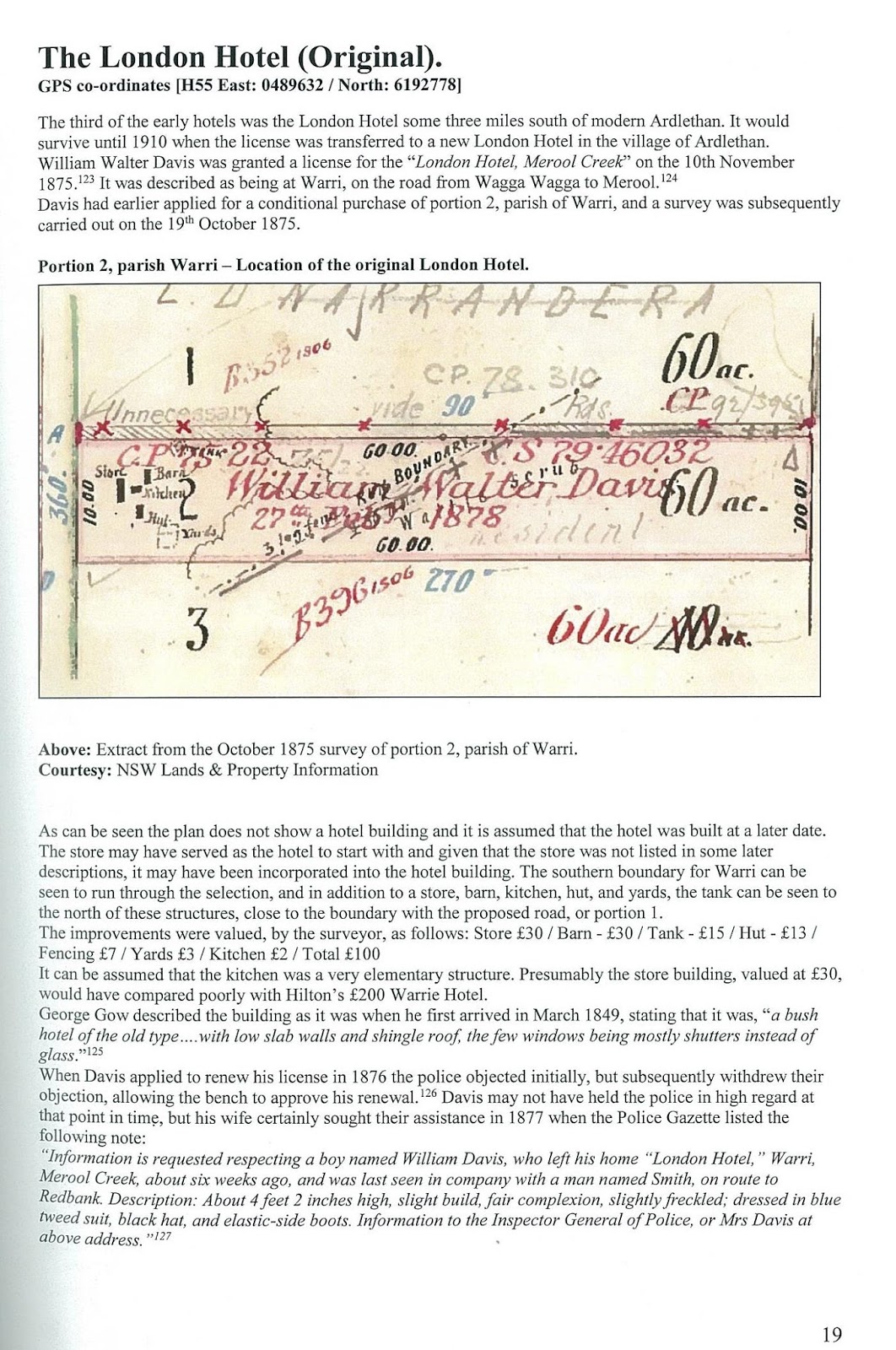
Early Hotels on the Mirrool Creek (west of Quandary), the establishment of Ardlethan, and the history of its two hotels, by Geoff Burch


Extensive research by local historian Geoff Burch again brings alive the history of a particular area, with information on early pastoral runs, with maps and photographs of the locations as they are today. 


 These books are now available for you to read within the library, with some for loan copies available soon. 

Friday, July 29, 2016

Fitz Noir: stories from Fitzmaurice Street 1920- 1925


the Daily Advertiser, Tuesday 18 August 1925


Many publications printed by groups of businessmen over the years, have presented Wagga Wagga as a stolid, staid and stuffy town. Despite this attempted gloss, the early history of Wagga Wagga turns up many gems, and the early 1920s was particularly rich in surprising events. 

Fitzmaurice Street in the early 1920s was a lively place, with the top four infringements people were charged with appearing to be as follows: Offensive behaviour, Riotous behaviour, Indecent language, and Loitering. Of these, riotous behaviour was the most popular, often involving drunken brawls, and other alcohol fuelled behaviours that were puzzling to hapless bystanders.


Indecent language was also popular in 1920s Wagga, with the actual language or words used described in very decorous and demure terms that gave no hint of the content, but the people of the time must have known what swear words of the day were most frequently used. Again it was mostly alcohol affected people loudly disclaiming near a convenient policeman on street patrol, with hopefully a group of suitably shocked persons witnessing the “crime”.
                                      the Daily Advertiser, Friday 22 April 1921                                            

Offensive behaviour was prevalent, though again, descriptions given were mild in comparison to today’s standards, and thumbing your nose at a policeman could get you arrested. 


the Daily Advertiser, Monday 9 February 1925

The other startling statistic from this time is the high number of traffic accidents, involving bolting horses, runaway horse and buggies, and car and motorbike accidents. Men of this time were used to performing great acts of derring do, leaping into runaway carts and pulling up the horse and saving the occupants of the cart or buggy. Men would do this at a moment’s notice so it must have been a fairly common occurrence to be that prepared and confident to stop a bolting horse. Mr Minty, of Minty’s garage fame, made it into the Daily Advertiser as one of many men who rescued people this way.


the Daily Advertiser, Tuesday 29 June 1920

Drink driving in cars was also common, and caused many fatalities and injuries ; people usually had excuses for their bad driving behaviours, as did this fellow ”it wasn’t the drink, it was the brakes Your Honour”

the Daily Advertiser, Monday 15 June 1925

Opium smoking was a social problem of the time, generally inhabitants of the town knew where the opium dens or smoking establishments were, and of course illegal gambling was huge at the time along with other less troubling entertainments. Unconscious people were often found lying in the street, sometimes outside opium dens, or pubs. The gaming house was shut down, as were the opium dens (eventually).

 
 the Daily Advertiser, Tuesday 24 February 1920


the Daily Advertiser, Tuesday 29 September 1925

But the best of all these stories are the oddities of Fitzmaurice Street. 

There was the shopkeeper’s parrot, who regularly drew an appreciative crowd: 

                                              the Daily Advertiser, Thursday 27 March 1924

The giant cod displayed in an oyster saloon window, and the story of the gruff fisherman who bagged the giant fish:

                                                the Daily Advertiser, Friday 14 March 1924

The Great Lobster Price Outrage of 1925:


the Daily Advertiser, Monday 10 August 1925

And finally,  the man who proudly displayed his arm length tattoo of a naked lady, was arrested but let off with a warning (after having the judge examine the tattoo closely) (and at length) to “keep your arm to yourself in future”


the Daily Advertiser, Tuesday 10 February 1920

You can uncover your own 1920s gems through Trove's newspaper search 

http://trove.nla.gov.au/newspaper/


Tuesday, June 28, 2016

Reports,studies,plans: three reserves of Wagga Wagga

The Wagga Wagga local studies collection contains many different types of reports on local landmarks and areas – three examples here are Willans Hill, Pomigalarna, and Wiradjuri reserves.

These sorts of reports contain useful historical information as well as facts about flora and fauna, and other environmental data, along with maps and statistics.

Pomigalarna Reserve, 1987. Compiled by The Friends of Pomigalarna Committee 


Highlight: Pomigalarna bird list

Willans Hill management plan, 1990. Prepared by the City of Wagga Wagga Parks and Recreation department

   
Highlightmap of original land grants in Willans Hill area


Wiradjuri Reserve, compiled in 1999. Alexandra Dalgliesh, Landscape Architect, for Wagga Wagga City Council

  
Highlight: map of Tin Town circa 1940s


These reports and many more are available in the local studies collection, and you may find some copies for loan within the general library collection. Come in and ask the friendly staff for assistance ! 


Monday, May 23, 2016

It’s about the books: celebrating the 70th birthday of the Wagga Wagga City Library


From : The Daily Advertiser, 25 May 1946


2016 is a big year for anniversaries – William Shakespeare, Charlotte Bronte’s Jane Eyre, and now, The Wagga Wagga City Library celebrates its 70th birthday. 


The Wagga Wagga City Library started with the Free Library Movement, active before 1946, with a group of dedicated people in the community taking action to establish a library for Wagga Wagga. The Patriotic Hut was bought by the then council, in 1946, to house the library, perhaps a fitting beginning at the end of World War Two. The first Wagga Free Library was a source of fierce civic pride, also showing what a progressive town Wagga Wagga was, in providing such a service.

Libraries are now much more than books, newspapers and magazines – although the heart of the library, through the Free Library Movement in Australia, has always been books, reading, and equity of access to books, and all the benefits those things bring.


Book History


Books themselves, as objects, are often not paid much attention to, but they are interesting for all the little details they present as a physical object, not just the topic or type of writing they hold. Depending on when they were printed, the cover, the paper used, the card in the pocket in the front of the book, the stamp used, all record details of its history that can enrich appreciation and understanding of a book. 

Next time you borrow an older book from the local studies collection, have a closer look- you may find some tiny detail you find intriguing :-)


The Wagga Wagga Local Studies Collection

The Wagga Wagga City Library Local Studies Collection is housed in the Rose Novak room, established in November 2004, and named after the librarian who started the collection, during her 22 years of service to the library.
The collection holds a sometimes weird and wonderful, sometimes commonplace, array of items, and this is added to every year. Some items are very old and frail, falling apart but held safe in the local studies room.
Some of our more famous collections within the collection:

The Tichborne collection contains both papers and books, including illustrations and articles from magazines of the time. The Tichborne case was an international sensation in the Victorian era, with the claimant to the Tichborne fortune finally being proved an imposter in the English court, and serving a total of ten years jail. 


Poet Mary Gilmore, an icon of Australian literary tradition, is also well represented, with an extensive collection of books available, as well as some ephemera from her visit to Wagga Wagga in 1947 for Children’s Book Week.


The Wiradjuri, First Peoples of this area, are represented in the local history collection, containing a range of books about Wiradjuri language, heritage, and survival. 


Book lists

The Daily Advertiser regularly ran a book list, featuring new items from non fiction, fiction, and later, audio recordings in the form of long playing vinyl records (or LPs for short- for those of us that remember them) and after that, films on reel. 

In later years, towards the mid to late fifties, book lists started becoming more detailed and recommended books for different kinds of reading - though providing the right book in any circumstance has, again, from the start of the Free Library movement, been a major concern for all library workers. 

Libraries in general, but Wagga Wagga City Library in particular, also saw themselves as providers of information- places where you could get information on just about anything. 


So...happy birthday, Wagga Wagga City Library ! When you come in and borrow, have a thought for the progressive people in 1946 who worked to bring this library service into existence, and celebrate the continuing legacy we have today :-)


Friday, April 29, 2016

The marriage of true minds: Wagga Wagga Shakespeare Club


As this year is the 400th anniversary of Shakespeare’s death – and as Wagga Wagga has always had a strong interest in Shakespeare (and things literary in general) I thought I’d look at the stronghold of Shakespeare in Wagga Wagga – The Shakespeare Club.
The Wagga Shakespeare Club started out as the Calliope Club, in 1904, and over the years there have been some changes to the name, and rules for the club, but overall the point of the club was to read, learn about and appreciate Shakespeare. The Shakespeare Ladies: A history of the Wagga Wagga Shakespeare Club by Jen Thompson, has one of the most evocative descriptions of early Wagga as an introduction to the story of the club’s formation. If you have ever tried to imagine early Wagga (and I have on many occasions) the book is worth reading for that description alone.
The club continued to meet during both world wars, adding tasks dedicated to help the war effort as well as reading Shakespeare to each other, meeting in members’ homes, bringing food to share along with the plays.
“…I am afraid Wagga is a very dull town, our people do not appreciate the works of Shakespeare nor the Players, for which I can’t forgive them.” Mrs Copland, circa 1920s, p. 30 of The Shakespeare Ladies by Jen Thompson 
Luckily things have changed since then J
 
Left: from The Daily Advertiser, 14 November 1914
 
Right: From The Daily Advertiser, 10 August 1920
 
In 2004 the Wagga Wagga City Library hosted a New South Wales State Library first folio edition of Shakespeare’s works, with John Bell, of Bell Shakespeare, opening the exhibition.
If you would like to look at a copy of the first folio, the State Library of New South Wales has a digitised copy on their website:   http://www.sl.nsw.gov.au/stories/shakespeares-first-folio
 
 
The Wagga Wagga Shakespeare Club continues to meet, in the Community Learning Space in the library.
 
Wagga Wagga City Library has a copy of The Shakespeare Ladies for loan, and extra copies in the local studies collection that can be read within the library. We also have an extensive Shakespeare collection you can borrow, including audio, so if you are inspired to re-read or maybe dip in for the first time, or listen to full dramatic productions of the plays, or watch the latest BBC production of Macbeth, come in and ask the friendly staff how you can access this amazing collection. The library also has some beautiful bookmarks to give away, from the New South Wales State Library, featuring the stained glass windows in their Shakespeare Room, which depict the seven ages of man from the “All the world’s a stage” speech from As you like it, so don’t forget to pick up your bookmark whilst stocking up on Shakespeare’s works.


Wednesday, March 30, 2016

When Hats were a thing : Prosperous Wagga Wagga,1926


I recently rediscovered a valuable resource in the local studies collection – a promotional booklet published by the Wagga Wagga Express in 1926. It's title is suitably and unnecessarily long : "Wagga Wagga  Its Resources for Primary and Secondary Industries". In broadsheet form, it contains what we might now call advertorials; also stories, photographs, statistics about businesses, utilities, the early history of Wagga Wagga, industries in the town and region – in short an excellent reference on the place and time of 1926.

I found the history of utilities extremely interesting – water, gas and electricity all provided by the council of the time – information on kilowatts, price, machinery and processes used, all described in detail. If you are writing the ultimate Wagga Wagga historical novel, then every bit of background information you’ll ever need is here J

Farming, stock sales, education, flour milling, parks and gardens: nearly every aspect of (respectable) town life you could think of is written about.   A couple of my favourite stories include the Riverina Fruit and Confectionery Distributors Wallace & Co., illustrated with a delightful photograph of a stockroom filled with boxes and boxes of delicious sweets stacked to the ceiling. 
The other story is of Anstice and Mackay – “Noted for Hats” – which was a business situated, in 1926, on the School of Arts corner, in Fitzmaurice Street. My favourite photograph is of the Hat Department display. 


Left : from the Daily Advertiser, August 1926

As with all items in the local studies collection, you are very welcome to come into the library and look at the different resources and discover how they may help you in your research - ask at the information desk! 

Tuesday, February 23, 2016

Birds of a feather : The Crow, the Annual magazine of the District Rural School Wagga Wagga


The annual magazine of the district Rural School in Wagga Wagga, The Crow, was published in the first half of the last century. The Wagga District Rural School was an earlier incarnation of the Gurwood Street school.  Wagga Wagga City Library holds some editions of the magazine, which have a quaint mixture of information about teachers, sports, students, articles written by students (and ex teachers and ex students), cartoons, short stories, poetry, advertisements from sponsors,and more.


These school magazines are a handy research item, containing such a diverse array of bits and pieces about school life in the earlier part of the last century. You never know what you will find – I learnt that there was a sport called Vigoro and it was pretty popular at the time, and is still played in Australia today.  Schools in Wagga Wagga and district had teams and competed with other country towns in the region, so it was a big part of school life back then.
It is also interesting to revisit pre-technology era cultural artifacts and discover how people communicated their culture to each other. Cartoons (and drawing in general) were a popular medium, as is the way Shakespeare is used to illustrate contemporary everyday school concerns and amusements.


These magazines are part of the Wagga Wagga City Library local studies collection and are available to view within the library. There are also a few copies from the latter part of last century, with greatly different production values and topics.


Images :  Cartoon , The Crow, September 1927

                Shakespearean Wisdom, The Crow, October 1928

                The Vigoro Team, The Crow, 1927

                Advertisements, The Crow, 1930