Monday, January 30, 2017

New year, new books in local studies


Menindee Girl : the story of my life, by Joyce Hampton nee King

The biography of local Indigenous Ngiyampaa Elder Joyce Hampton, filled with drawings, photographs and her personal history within the broader political context, is a great read.  I found the descriptions of mission life factual and moving, giving a sense of the conditions Indigenous persons were forced to endure.

Wagga Wagga City Library will be hosting a book launch for Menindee Girl on Thursday February 9 at 6pm. You can book a place by ringing the library on 69269700 or emailing wcl@wagga.nsw.gov.au


Country  Women – Hold the Key : Celebrating the 90th Anniversary of the First Riverina Group Conference .  by  the Riverina Group of CWA of NSW, Wagga Wagga


This interesting history of the CWA in our local area also covers CWA branches in Pleasant Hills, Galore Hill, Urana, and Wantabadgery.  Established in the early 1920s, the CWA has held (too numerous to mention) fund raising events over the years, in order to  assist others in country areas. This history also contains comprehensive lists of office bearers and photographs of various groups of women active in the local area.

Murrumbidgee Gentlemen : History of Narrandera’s Murrumbidgee Club 1903 -2003 , by Norman Houghton

Formed in 1903 in Narrandera, the Murrumbidgee Club was a gentleman’s “…social, literary, recreational and all other purposes lawfully  permissible to a registered club’ (p2) The building itself was a beautiful old house originally built in 1898, with space eventually dedicated to a reading room, a ballroom, a bar, a billiards room , all established over the years by purchasing local properties and adapting them for the purpose. The Club even had a roulette wheel operating in 1937, with other events such as balls, dinners, and polo matches held.
Women were not allowed in the club, but :
“The Club ladies were appreciated in odd ways. They were asked to comment on the design and layout of a proposed new kitchen in 1952 but were still not permitted to join the club.” P 53,  Murrumbidgee Gentlemen

Gentlemen Only : A History of the Riverine Club 1881 – 2016 by Norman Houghton


Norman Houghton has written another excellently researched and presented history of a local men’s club, the difference being here that the Riverine Club is still active and has evolved to admit women to use the premises and services of the club. Again there are some really beautiful black and white photos of the different rooms and the building itself, along with plans, ephemera from social events and extensive lists of members, office bearers and other people associated with the club through the years.


All these items are available for viewing within the library as part of the local studies collection.


Thursday, November 24, 2016

Family History - Genealogy resources in reference


Are you researching your family history? The Wagga Wagga City Library has many different resources to help your search. Though a lot of resources are available online (we do have the library edition of Ancestry available to use in the library) we also have many books in the genealogy section that may be of use to you.

Here's a selection to get you started:


Tracing births, deaths and marriages at sea by Christopher T & Michael J Watts

This little book covers pretty comprehensively everything you would want to know about searching for these kinds of records. At first it may seem an obscure topic but as travelling by sea was so common in times past, it may be helpful for those trying to find missing ancestors where records stop or start at sea.

"In this book we will concentrate not so much on such myths, and legal niceties, but rather upon the more practical aspects of just what records of such events have survived, what they might reveal and where to find them."
 Tracing births, deaths and marriages at sea, p 1


Sydney Burial Ground (Elizabeth and Devonshire Streets) and history of Sydney's early cemeteries from 1788 by Keith A Johnson and Malcolm R Sainty

A detailed study with photographs and encyclopedic indexes and appendices and explanations of the records ( for example, Licences and Butt Books). There is a potted history of the earliest burial grounds 1788-1901. Interesting to note that the Sydney Burial Ground was removed to make way for the Sydney Central Station.

"In 1901 the New South Wales Government invited descendants and relatives of those interred at the Sydney at The Sydney Burial Ground to relocate the monuments and remains. The cemetery had been closed fro more than twelve years and presented a deserted and neglected appearance."
Sydney Burial Ground p. 35 


Researching Australian School Records: A Guide for Family Historians and Local History Enthusiasts, by Geoffrey Burkhardt

Maybe school records are not an immediately obvious avenue for genealogical research, but they may give a personal touch to a person's history where other records may be considered austere or unforthcoming. This book's Australian focus makes it super helpful.
"In seeking out the school record sources described above, particularly the manuscript sources, family historians need to be resourceful and not just rely on state archive repositories."
 Researching Australian School Records p. 55

The Genealogy reference section contains many more resources including shipping records, how-tos on finding records and people, and many other gems besides. Browse the shelves or ask the friendly staff for assistance :-)


Thursday, October 27, 2016

Imposter or not ? Arthur Orton, Tom Castro and the Tichborne story


The strange story of Roger Tichborne continues to fascinate people, prompting new research and new books on the subject.

The Claimant, by Paul Terry, adds to this body of work, and the bizarre circumstances surrounding the story of the imposter Tom Castro, the Baronet Roger Tichborne, and Arthur Orton the Butcher's son are set out clearly in this new work. As Paul Terry points out, the case put Wagga Wagga on the map and :
Wagga was now synonymous with it's most infamous resident
p 104, The Claimant, by Paul Terry


The man who lost himself: the unbelievable story of the Tichborne claimant, by Robyn Annear, is another very readable account of the Tichborne story. Ms Annear's account has a more humorous slant, with a focus on some of the weirder tales associated with  the case, but is still a proper piece of historical research. 

...between eight and ten thousand people gathered outside the court, morning and afternoon, to catch a glimpse of their champion, the Claimant.
p. 351, The man who lost himself, by Robyn Annear

For those of you who prefer their information with a more scholarly bent, we also have :


Rohan McWilliam is an English university professor and accordingly writes his account of the Tichborne tale with literary flair and historical accuracy. Particularly interesting are references to the street ballads of the time, songs about Tichborne and the surrounding controversy, lies and legend.

Up to the mid-Victorian period, the broadside ballad sung at a fair or street corner was a much loved form of popular culture. One of the most popular topics in the 1870s was the Tichborne Claimant.
p.213, The Tichborne Claimant: A Victorian Sensation, by Rohan McWilliam

The titles covered here are available for loan at Wagga Wagga City Library, but if you miss out there are copies in local studies you can read within the library. Brush up on your knowledge on Wagga's most famous infamous court case and suprise and amuse your friends with anecdotes from these three excellent histories :-)

Thursday, September 29, 2016

Tunnel vision : Railway Hotels of Victoria and New South Wales


Wagga Wagga City Library recently hosted a book launch for the second volume of Scott Whitaker's series on railway hotels in Australia and the library has purchased both volumes for the local studies collection. 

Both of these beautifully produced volumes contain factual information as well as stories, advertisements, maps, photographs, a bibliography, and a very welcome index. 

Railway Hotels of Australia volume one : Victoria, has all the famous (and infamous) railway hotels including Glenrowan, Castlemaine, and Ballarat, which boasted four or five hotels during the heyday of rail travel in the 1800s. 

From volume one, Railway Hotels of Australia : Victoria

Railway Hotels of Australia volume two : New South Wales includes 3 railway hotels for Wagga Wagga, the first being active from 1874 to 1922, the second being a hotel expressly set set for the use of railway labourers circa 1878. Another interesting fact is that Wagga Wagga had "...185 hotels in the electorate, and the statutory number was 76," (p 261 Railway Hotels of Australia volume 2 : New South Wales) so the Licenses Reduction Board had to get rid of 44 of those excess hotels. That's a lot of hotels :-) 

The Astor Hotel which currently stands on the corner of Station Place and Edward streets, replaced the original Kerr's Wagga Hotel, and you can read the story of why railway hotel names in Wagga Wagga were interchangeable at this time.


From volume two, Railway Hotels of Australia: New South Wales

These books are now available for you to look at within the library. 


Tuesday, August 30, 2016

New books in Local Studies


The Local Studies collection at Wagga Wagga City Library has three new books this week, two histories and a collection of mini personal histories of Wagga luminaries.

We are. Wagga Wagga, produced by Belinda Benson, Peita Vincent, Jaqueline Cooper, Elizabeth Robinson and Alexandra Chubb, is compilation of great stories about a wide range of Wagga Wagga people including comedian Dane Simpson and entrepreneur Simone Eyles.


Pomingalarna, by Geoff Burch


The history of the Pomingalarna Run, the homestead, the commons, and the mines in this area of Wagga Wagga. Contains meticulous research as ever by Geoff Burch, with maps and photographs showing the old Pomingalarna in current day context.


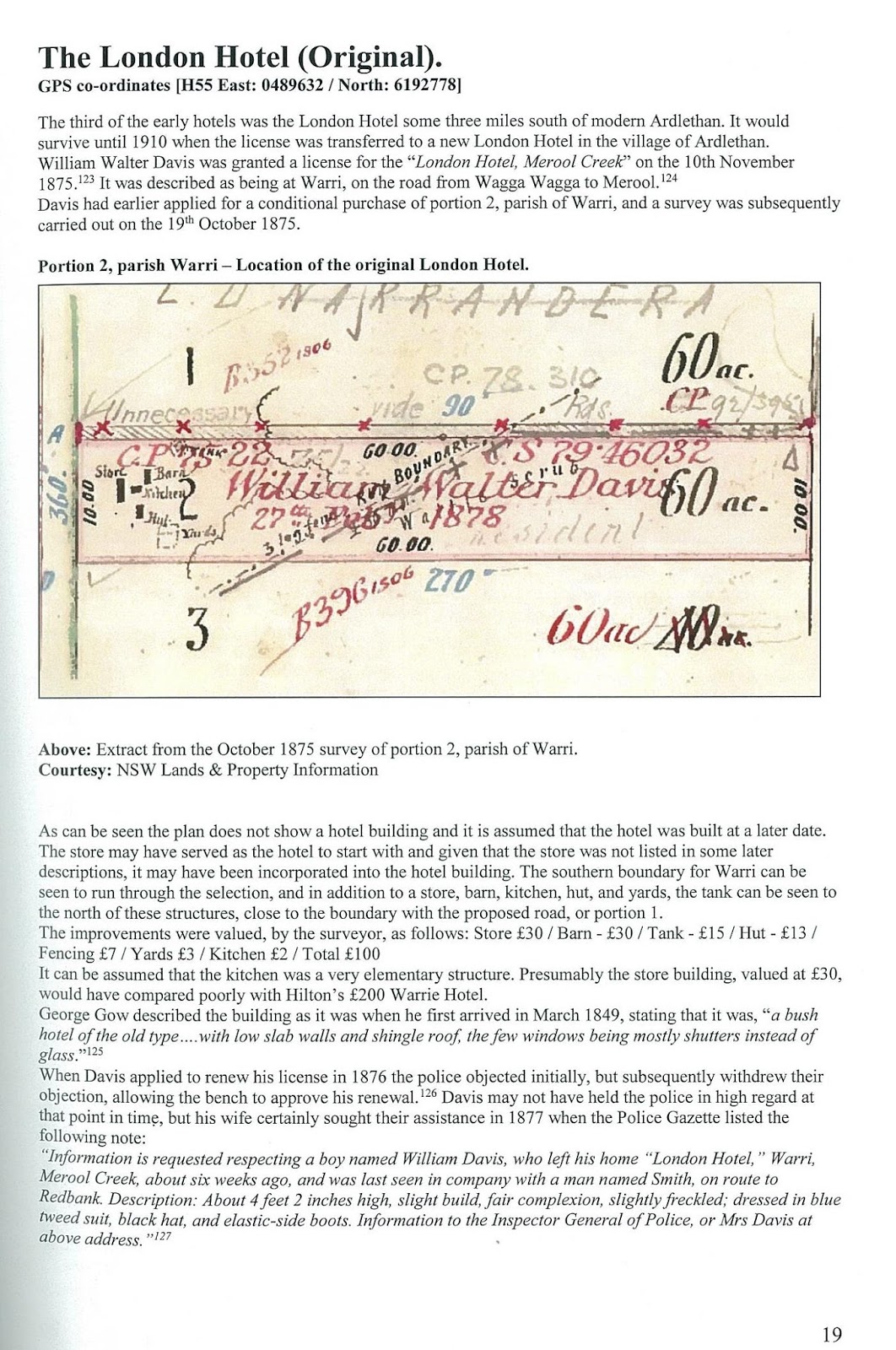
Early Hotels on the Mirrool Creek (west of Quandary), the establishment of Ardlethan, and the history of its two hotels, by Geoff Burch


Extensive research by local historian Geoff Burch again brings alive the history of a particular area, with information on early pastoral runs, with maps and photographs of the locations as they are today. 


 These books are now available for you to read within the library, with some for loan copies available soon. 

Friday, July 29, 2016

Fitz Noir: stories from Fitzmaurice Street 1920- 1925


the Daily Advertiser, Tuesday 18 August 1925


Many publications printed by groups of businessmen over the years, have presented Wagga Wagga as a stolid, staid and stuffy town. Despite this attempted gloss, the early history of Wagga Wagga turns up many gems, and the early 1920s was particularly rich in surprising events. 

Fitzmaurice Street in the early 1920s was a lively place, with the top four infringements people were charged with appearing to be as follows: Offensive behaviour, Riotous behaviour, Indecent language, and Loitering. Of these, riotous behaviour was the most popular, often involving drunken brawls, and other alcohol fuelled behaviours that were puzzling to hapless bystanders.


Indecent language was also popular in 1920s Wagga, with the actual language or words used described in very decorous and demure terms that gave no hint of the content, but the people of the time must have known what swear words of the day were most frequently used. Again it was mostly alcohol affected people loudly disclaiming near a convenient policeman on street patrol, with hopefully a group of suitably shocked persons witnessing the “crime”.
                                      the Daily Advertiser, Friday 22 April 1921                                            

Offensive behaviour was prevalent, though again, descriptions given were mild in comparison to today’s standards, and thumbing your nose at a policeman could get you arrested. 


the Daily Advertiser, Monday 9 February 1925

The other startling statistic from this time is the high number of traffic accidents, involving bolting horses, runaway horse and buggies, and car and motorbike accidents. Men of this time were used to performing great acts of derring do, leaping into runaway carts and pulling up the horse and saving the occupants of the cart or buggy. Men would do this at a moment’s notice so it must have been a fairly common occurrence to be that prepared and confident to stop a bolting horse. Mr Minty, of Minty’s garage fame, made it into the Daily Advertiser as one of many men who rescued people this way.


the Daily Advertiser, Tuesday 29 June 1920

Drink driving in cars was also common, and caused many fatalities and injuries ; people usually had excuses for their bad driving behaviours, as did this fellow ”it wasn’t the drink, it was the brakes Your Honour”

the Daily Advertiser, Monday 15 June 1925

Opium smoking was a social problem of the time, generally inhabitants of the town knew where the opium dens or smoking establishments were, and of course illegal gambling was huge at the time along with other less troubling entertainments. Unconscious people were often found lying in the street, sometimes outside opium dens, or pubs. The gaming house was shut down, as were the opium dens (eventually).

 
 the Daily Advertiser, Tuesday 24 February 1920


the Daily Advertiser, Tuesday 29 September 1925

But the best of all these stories are the oddities of Fitzmaurice Street. 

There was the shopkeeper’s parrot, who regularly drew an appreciative crowd: 

                                              the Daily Advertiser, Thursday 27 March 1924

The giant cod displayed in an oyster saloon window, and the story of the gruff fisherman who bagged the giant fish:

                                                the Daily Advertiser, Friday 14 March 1924

The Great Lobster Price Outrage of 1925:


the Daily Advertiser, Monday 10 August 1925

And finally,  the man who proudly displayed his arm length tattoo of a naked lady, was arrested but let off with a warning (after having the judge examine the tattoo closely) (and at length) to “keep your arm to yourself in future”


the Daily Advertiser, Tuesday 10 February 1920

You can uncover your own 1920s gems through Trove's newspaper search 

http://trove.nla.gov.au/newspaper/


Tuesday, June 28, 2016

Reports,studies,plans: three reserves of Wagga Wagga

The Wagga Wagga local studies collection contains many different types of reports on local landmarks and areas – three examples here are Willans Hill, Pomigalarna, and Wiradjuri reserves.

These sorts of reports contain useful historical information as well as facts about flora and fauna, and other environmental data, along with maps and statistics.

Pomigalarna Reserve, 1987. Compiled by The Friends of Pomigalarna Committee 


Highlight: Pomigalarna bird list

Willans Hill management plan, 1990. Prepared by the City of Wagga Wagga Parks and Recreation department

   
Highlightmap of original land grants in Willans Hill area


Wiradjuri Reserve, compiled in 1999. Alexandra Dalgliesh, Landscape Architect, for Wagga Wagga City Council

  
Highlight: map of Tin Town circa 1940s


These reports and many more are available in the local studies collection, and you may find some copies for loan within the general library collection. Come in and ask the friendly staff for assistance !