Monday, May 23, 2016

It’s about the books: celebrating the 70th birthday of the Wagga Wagga City Library


From : The Daily Advertiser, 25 May 1946


2016 is a big year for anniversaries – William Shakespeare, Charlotte Bronte’s Jane Eyre, and now, The Wagga Wagga City Library celebrates its 70th birthday. 


The Wagga Wagga City Library started with the Free Library Movement, active before 1946, with a group of dedicated people in the community taking action to establish a library for Wagga Wagga. The Patriotic Hut was bought by the then council, in 1946, to house the library, perhaps a fitting beginning at the end of World War Two. The first Wagga Free Library was a source of fierce civic pride, also showing what a progressive town Wagga Wagga was, in providing such a service.

Libraries are now much more than books, newspapers and magazines – although the heart of the library, through the Free Library Movement in Australia, has always been books, reading, and equity of access to books, and all the benefits those things bring.


Book History


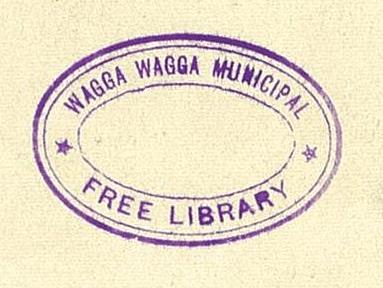
Books themselves, as objects, are often not paid much attention to, but they are interesting for all the little details they present as a physical object, not just the topic or type of writing they hold. Depending on when they were printed, the cover, the paper used, the card in the pocket in the front of the book, the stamp used, all record details of its history that can enrich appreciation and understanding of a book. 

Next time you borrow an older book from the local studies collection, have a closer look- you may find some tiny detail you find intriguing :-)


The Wagga Wagga Local Studies Collection

The Wagga Wagga City Library Local Studies Collection is housed in the Rose Novak room, established in November 2004, and named after the librarian who started the collection, during her 22 years of service to the library.
The collection holds a sometimes weird and wonderful, sometimes commonplace, array of items, and this is added to every year. Some items are very old and frail, falling apart but held safe in the local studies room.
Some of our more famous collections within the collection:

The Tichborne collection contains both papers and books, including illustrations and articles from magazines of the time. The Tichborne case was an international sensation in the Victorian era, with the claimant to the Tichborne fortune finally being proved an imposter in the English court, and serving a total of ten years jail. 


Poet Mary Gilmore, an icon of Australian literary tradition, is also well represented, with an extensive collection of books available, as well as some ephemera from her visit to Wagga Wagga in 1947 for Children’s Book Week.


The Wiradjuri, First Peoples of this area, are represented in the local history collection, containing a range of books about Wiradjuri language, heritage, and survival. 


Book lists

The Daily Advertiser regularly ran a book list, featuring new items from non fiction, fiction, and later, audio recordings in the form of long playing vinyl records (or LPs for short- for those of us that remember them) and after that, films on reel. 

In later years, towards the mid to late fifties, book lists started becoming more detailed and recommended books for different kinds of reading - though providing the right book in any circumstance has, again, from the start of the Free Library movement, been a major concern for all library workers. 

Libraries in general, but Wagga Wagga City Library in particular, also saw themselves as providers of information- places where you could get information on just about anything. 


So...happy birthday, Wagga Wagga City Library ! When you come in and borrow, have a thought for the progressive people in 1946 who worked to bring this library service into existence, and celebrate the continuing legacy we have today :-)


Friday, April 29, 2016

The marriage of true minds: Wagga Wagga Shakespeare Club


As this year is the 400th anniversary of Shakespeare’s death – and as Wagga Wagga has always had a strong interest in Shakespeare (and things literary in general) I thought I’d look at the stronghold of Shakespeare in Wagga Wagga – The Shakespeare Club.
The Wagga Shakespeare Club started out as the Calliope Club, in 1904, and over the years there have been some changes to the name, and rules for the club, but overall the point of the club was to read, learn about and appreciate Shakespeare. The Shakespeare Ladies: A history of the Wagga Wagga Shakespeare Club by Jen Thompson, has one of the most evocative descriptions of early Wagga as an introduction to the story of the club’s formation. If you have ever tried to imagine early Wagga (and I have on many occasions) the book is worth reading for that description alone.
The club continued to meet during both world wars, adding tasks dedicated to help the war effort as well as reading Shakespeare to each other, meeting in members’ homes, bringing food to share along with the plays.
“…I am afraid Wagga is a very dull town, our people do not appreciate the works of Shakespeare nor the Players, for which I can’t forgive them.” Mrs Copland, circa 1920s, p. 30 of The Shakespeare Ladies by Jen Thompson 
Luckily things have changed since then J
 
Left: from The Daily Advertiser, 14 November 1914
 
Right: From The Daily Advertiser, 10 August 1920
 
In 2004 the Wagga Wagga City Library hosted a New South Wales State Library first folio edition of Shakespeare’s works, with John Bell, of Bell Shakespeare, opening the exhibition.
If you would like to look at a copy of the first folio, the State Library of New South Wales has a digitised copy on their website:   http://www.sl.nsw.gov.au/stories/shakespeares-first-folio
 
 
The Wagga Wagga Shakespeare Club continues to meet, in the Community Learning Space in the library.
 
Wagga Wagga City Library has a copy of The Shakespeare Ladies for loan, and extra copies in the local studies collection that can be read within the library. We also have an extensive Shakespeare collection you can borrow, including audio, so if you are inspired to re-read or maybe dip in for the first time, or listen to full dramatic productions of the plays, or watch the latest BBC production of Macbeth, come in and ask the friendly staff how you can access this amazing collection. The library also has some beautiful bookmarks to give away, from the New South Wales State Library, featuring the stained glass windows in their Shakespeare Room, which depict the seven ages of man from the “All the world’s a stage” speech from As you like it, so don’t forget to pick up your bookmark whilst stocking up on Shakespeare’s works.


Wednesday, March 30, 2016

When Hats were a thing : Prosperous Wagga Wagga,1926


I recently rediscovered a valuable resource in the local studies collection – a promotional booklet published by the Wagga Wagga Express in 1926. It's title is suitably and unnecessarily long : "Wagga Wagga  Its Resources for Primary and Secondary Industries". In broadsheet form, it contains what we might now call advertorials; also stories, photographs, statistics about businesses, utilities, the early history of Wagga Wagga, industries in the town and region – in short an excellent reference on the place and time of 1926.

I found the history of utilities extremely interesting – water, gas and electricity all provided by the council of the time – information on kilowatts, price, machinery and processes used, all described in detail. If you are writing the ultimate Wagga Wagga historical novel, then every bit of background information you’ll ever need is here J

Farming, stock sales, education, flour milling, parks and gardens: nearly every aspect of (respectable) town life you could think of is written about.   A couple of my favourite stories include the Riverina Fruit and Confectionery Distributors Wallace & Co., illustrated with a delightful photograph of a stockroom filled with boxes and boxes of delicious sweets stacked to the ceiling. 
The other story is of Anstice and Mackay – “Noted for Hats” – which was a business situated, in 1926, on the School of Arts corner, in Fitzmaurice Street. My favourite photograph is of the Hat Department display. 


Left : from the Daily Advertiser, August 1926

As with all items in the local studies collection, you are very welcome to come into the library and look at the different resources and discover how they may help you in your research - ask at the information desk! 

Tuesday, February 23, 2016

Birds of a feather : The Crow, the Annual magazine of the District Rural School Wagga Wagga


The annual magazine of the district Rural School in Wagga Wagga, The Crow, was published in the first half of the last century. The Wagga District Rural School was an earlier incarnation of the Gurwood Street school.  Wagga Wagga City Library holds some editions of the magazine, which have a quaint mixture of information about teachers, sports, students, articles written by students (and ex teachers and ex students), cartoons, short stories, poetry, advertisements from sponsors,and more.


These school magazines are a handy research item, containing such a diverse array of bits and pieces about school life in the earlier part of the last century. You never know what you will find – I learnt that there was a sport called Vigoro and it was pretty popular at the time, and is still played in Australia today.  Schools in Wagga Wagga and district had teams and competed with other country towns in the region, so it was a big part of school life back then.
It is also interesting to revisit pre-technology era cultural artifacts and discover how people communicated their culture to each other. Cartoons (and drawing in general) were a popular medium, as is the way Shakespeare is used to illustrate contemporary everyday school concerns and amusements.


These magazines are part of the Wagga Wagga City Library local studies collection and are available to view within the library. There are also a few copies from the latter part of last century, with greatly different production values and topics.


Images :  Cartoon , The Crow, September 1927

                Shakespearean Wisdom, The Crow, October 1928

                The Vigoro Team, The Crow, 1927

                Advertisements, The Crow, 1930


Tuesday, January 19, 2016

Education in Wagga Wagga : three local schools

Wagga Wagga City Library's local history collection has a number of school histories, so here are three to get us started:


Wagga Wagga Grammar School 1915 – 1946, by Sherry Morris and Phyllis de Jersey


The history of a private school in Wagga Wagga, bought in 1914 by Eileen and Dora Day, open through to World War Two, closing in 1946. Reminiscences from students, photographs, details of courses and tales of The Day family who ran the school, gives a cosy and very local aspect to school history.


Above: from the Daily Advertiser, December 1940


Brass bells and ink wells: A history of Wagga Wagga Public School, 1861-1997

Otherwise known as the Gurwood Street School, the Wagga Wagga Public School has a long and illustrious history through its various incarnations, starting in 1851, and still operating today. It features an excellent map showing the different buildings pertinent to the school grounds and times they were established.


Above : from the Daily Advertiser, August 1937


The Belltower : A history of the South Wagga Wagga Public School 1892 -1992 , by Ruth Lewis

A detailed account of the South Wagga Wagga Public School, with maps, plans, photographs and ex-students memories of their time there. Some of the more famous ex- students include cricketer Mark Taylor, General Thomas Blamey, and Bill Kerr, who was a radio and movie star during the early part of the last century.


Left : from the Daily Advertiser, April 1942


The Wagga Wagga City Library local studies collection has much education related material available to view within the library, so if you are researching the subject or just have a general interest in local history come down and have a look ! 

Thursday, November 26, 2015

A refreshing cup : Wagga Wagga's Cafe Society 1920 - 1954


Above : from The Daily Advertiser, January 1943

Cafes were a huge part of the community in the first part of the 20th century.  More than just providers of food and drink, cafes were meeting places, landmarks for giving directions to events or other businesses, and they hosted events and parties of all kinds. 


Street stalls were part of the war time fundraising effort and directions for such were printed in the newspaper when announcing when and where the stalls were operating. People could buy goods from the stalls and the money raised went to supporting war related or other similar charities.  The Greek café community in Wagga Wagga also contributed greatly to the war effort by raising large amounts of money in 1942.

Above : from The Daily Advertiser, December 1942

Cafes also made the news through brawls, breaching food health and safety laws, people behaving weirdly (yelling or knocking tables and chairs over) and being removed from the premises, fires, and over pricing of cigarettes, to name but a few examples. Farewells and bridge nights, engagement parties, musical evenings, in fact anything that involved people gathering for an event would most likely involve one of Wagga’s many cafes.


Above: from The Daily Advertiser, March 1923


Here is a by no means exhaustive list of cafes operating in Wagga Wagga from 1920 to 1954 :  


Riverina Café (Gurwood Street) 1920
St John’s Café (Baylis Street) 1921
Austral Café 1923
Mother’s Union Café 1926
Picone’s Café 1928
Wonderland Café (adjoins the Strand arcade) 1928
Siver Key Café  (Baylis Street) 1929
Page’s Wattle Café, 1930
White Rose Café 1931
Majestic Café (Gurwood Street) 1932
Black Cat Café (240 Baylis Street) 1933
Popular Café, (Fitzmaurice Street) 1933
Watson’s Café  1933
Café Royal (210 Baylis Street) 1934
Elizabeth Café (over Edmondson’s in Gurwood Street) 1934
Toby’s Tavern, ( Glamis Court, Gurwood Street) 1938
Continental Café 1940
Aussie Café 1942
Blue Moon Café (next to the Plaza Theatre) 1943
Crown Corner Café 1948
Alpine Café 1948
Ideal Café (Baylis Street) 1950
Bidgee Café 1951
Bridge Café 1951


In the early part of the 20th century the  Café Chantant was also popular, a form of café event held outside in garden settings, where people sang and recited poetry and stalls sold different foods like ice creams and fizzy drinks, tea, coffee and little cakes. Gardens at twilight, with strings of fairy lights and Chinese lanterns decorating the trees, were pretty backdrops for the evening's programme. Mount Erin held a number of successful Café Chantants in the 1920s.


Above : from The Daily Advertiser, November 1928


The Bridge Café is famous in Wagga Wagga’s history and is featured in Selling an American Dream : Australia’s Greek Café, the book accompanying the national travelling exhibition in 2013. Lex Marinos is a descendant of the original owner of the Bridge café, Anthony Karofilis. This book is part of the Wagga Wagga City Library local studies collection and is available to view within the library.

Above : from The Daily Advertiser, May 1951


Above : Anthony Karofilis and staff, Bridge Cafe Wagga Wagga, 1950s. From  Selling an American dream : Australia's Greek Cafe


Thursday, October 29, 2015

Different faces of Wagga Wagga : new books in local studies


The 1960s Aboriginal Fruit-Picking Scheme – A critical evaluation: An instructive history of social policy, social work, and Central Australian Aborigines by Milton James.
This study of the policies, procedures and outcomes of a fruit-picking scheme created to solve a labour shortage in selected rural areas covers the groups based at Gundagai, Leeton and Griffith, amongst others further afield.
The study contains statistics regarding pay rates, properties used in the scheme, as well as reminiscences from various people involved, from property owners to workers.


Wiradjuri Reserve Gobba Beach (Murrumbidgee River): Statement of Significance for an Aboriginal Place Declaration. Compiled by Go Green Services, Wagga Wagga.

Another extensively researched and readable report from Dick Green at Go Green Services, containing Indigenous history, maps, environmental facts, photographs and more.  There is a copy of this book in the general collection as well as in local studies, and is available for loan.


Faces of Wagga Wagga by John Egan.

A series of portraits of people who have contributed to the local community in diverse ways, taken by the photographer (and author) John Egan. There is a copy of this book in the general  collection as well as local studies.